Tuesday, 6 March 2012

C630M`s 2000 & 2006 - Montreal`s Finest

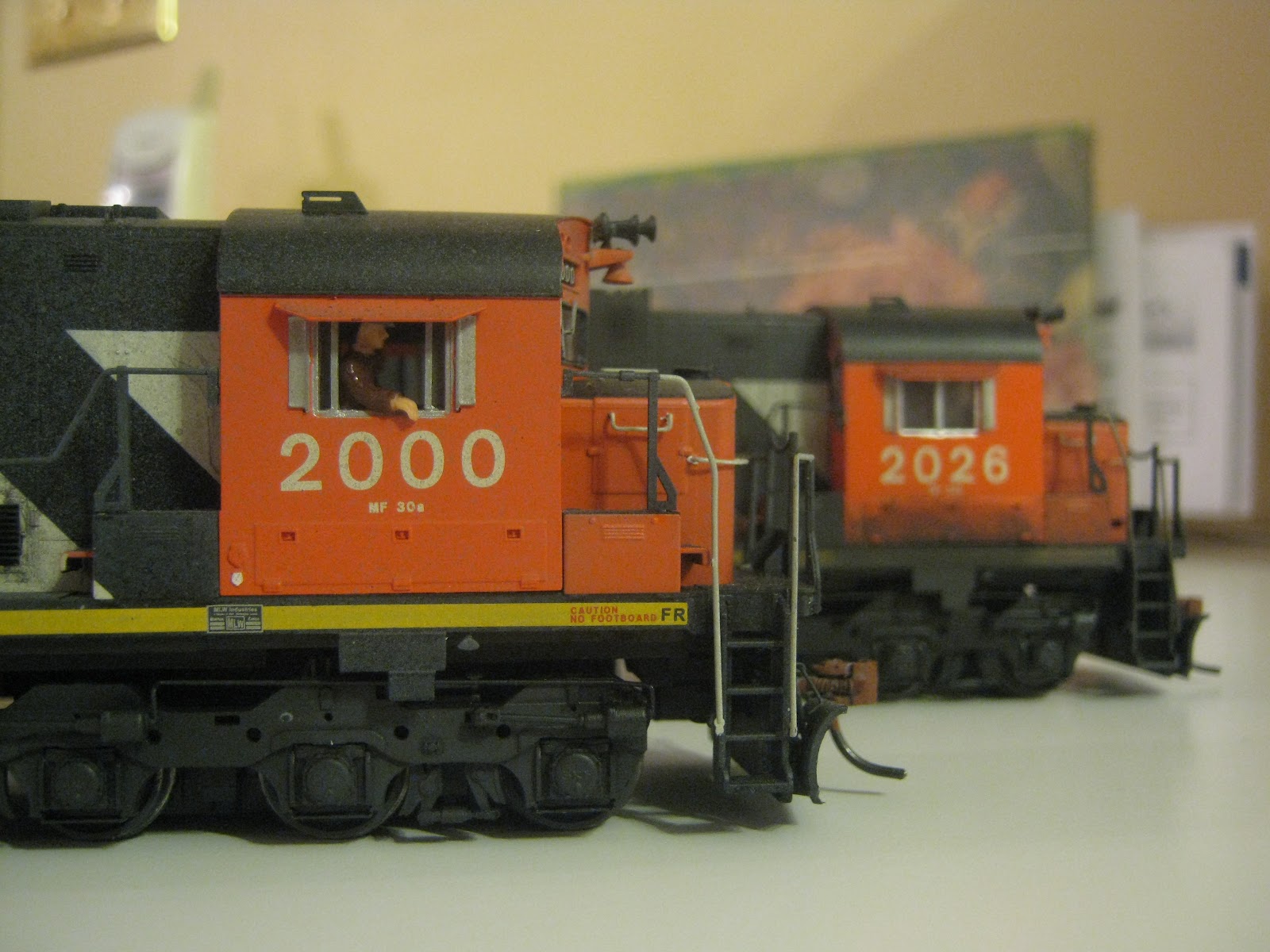
When Bowser announced a run of C630M`s in HO it wasn`t long before I had my name down on the waiting list.  When these engines finally arrived in the mailbox nearly two years later I knew I was looking at my favorite engines.   Not only do they look good but they run great too!  They pull a lot, run quiet and required little change.

CN ordered 44 of the C630M`s from MLW in 1967-68.  They were numbered 2000-2043.  2000-2002 were classified as MR-30a with the remaining 42 units falling into the MR-30b designation.  In 1969 the units were switched from MR-MF, with the "R" designating a road switcher and the "F" signifying a freight locomotive.  The main difference between the two was that the first two units were equipped with dynamic brakes while the others were not.  These "Big M's" were launched under the "Century" line and were similar in design to the ALCO C630.  They rode on Canadian made Dofasco trucks, output 3000HP and featured a V-16, 251E prime mover under the hood.   (http://cnlines.ca/)

2000 was the first C630M delivered to CN. It was built in 1967, retired in 1999 and sold for scrap.  2026 on the other hand was built in 1968 and retired sometime between 1992 and 1996.  It was also sold for scrap. (http://cnlines.ca/)


Here are my weathered and detailed versions of these brutes:

The weathering is a custom mix of acrylic paints.  2026 is more heavily weathered that 2000.
The Bowser model, had a third class light above the numberboards, which is correct for other roads but not CN.  I had to file them off, fill the holes and paint the spots.  A little weathering hides any trace.  The horn also had to be painted black.
The only complaint I have with these models are the thin handrails and a few "bends" can be seen.
As mentioned earlier, 2026 didn't have dynamic brakes, so those had to go.  I decided to add the as delivered air filter cover to 2000.  It almost seems wrong to cover those cool square filters CN added but it had to be done to one of the two.  The parts came with the locomotives.
I decided to open 2000's cab windows and place an engineman and conductor on either side.  I guess you could say that's L.K. Main in the engineer's seat.  These happened to be one of his favorite locomotives to operate.


I didn't take any photos of the conductors side for some reason, but handbrake chains were added on the front trucks along with a pair of rerailers behind the cab on the walkway.

All in all I really like these units.  They really added to my existing MLW and GMDD fleet.

Derailment in St John, NB

Sticking with my "Atlantic" theme I'd like to share any relevant railway news with my readers.  

My first new item however, is not on good terms.  Is seems a small CN potash train derailed on an New Brunswick Southern Railway (NBSR) spur on Tuesday.  

Four cars rolled over and a eight other cars went on the ground.  No one was hurt.

Here's the CBC article:
http://www.cbc.ca/news/canada/new-brunswick/story/2012/03/06/nb-train-derailment-potash.html

Monday, 5 March 2012

My Layout at a Glance

Five years ago I was visiting my grandparents in Quebec.  My grandfather and one of my uncles had built a small layout in their basement back in the late 70's or early 80's.  After they tore it down (long before my time) my grandfather built an oak display case that mostly had a few engines and some rolling stock in it.  It had hung on the wall for years but this time I decided to ask him about them.  Long story short I winded up with plenty of rolling stock and engines, mostly by Life Like and Bachmann, but even some old Britsh OO Triang-Hornby stuff too.  I also got a dozen buildings and that was about it.  When I got it home I decided to build a layout, which was basically a circle on a 4'x8' sheet of plywood.  As time went on, I constantly changed everything until there were no rements of the original layout left.  I had no knowledge at the time and I eyeballed everything, from grades to turns, and I paid for it.  Most of the mainline corners were either 15" radius sectional track or eyeballed flex track.  As for the grades I really have no idea as they are changed now, but they were certainly more than 5%. 

I had done little planning but there were a few things I knew I wanted for sure.  I wanted several bridges, a bit of a yard, some sort of industry for switching.  Most of all however, I wanted to loosely model Atlantic Canada, particurally the Gaspe region.  We have always had two or three hobby shops on the Island, but by this time they had long since stopped carrying anything related to model railroading.  I quickly learned two things: 1) scratchbuild what I can or use what is available locally and 2) mail order for the rest.  The idea of scratchbuilding has stuck with me ever since and my skills have come a long way.

Hard to see in this shot but the CN F7's and Life Like Amtrak cars are actually sitting in my old yard, a three siding type of deal on a big slope.


Looking north down what was Main Street.  The hand painted lines and cars that are no more than a crudely painted body on wheels certainly add to this shot.
Here's an example of my early scratchbuilding and using what was available.  The ballast was sand with gray primer or small rocks added.  The hopper car loads were made from sand glued to stiff paper painted gray.


I worked on the scenery on and off for a few years, thinking that it would make up for the poor track standards...and boy was I wrong.  Overtime, I began to upgrade my locomotives and old cars and eventually, I ended up retiring all of them.  I now have quite a fleet of CN power, from the smoking MLW's to the old reliable GMDD's. 

Late last summer I decided that I was going  bite the bullet and relay all the track.  I can now say that I am nearly finished, except for the yard leads and the track connecting the tall bridge to the rest of the mainline.  It runs much better now and I am beginning to see my work pay off.

As of tonight, it looks like this:
Forest Lumber Company
Engine Shops, fueling area and yard.  The weathering on the CP cylindrical hopper was one of my first attempts, and its to be touched up eventually.
Overview of the yard, shops and station.  The hole in the middle is so I can reach all areas and is usually covered.
Head on meet at Bedfore Station between two pairs of GMDD GP40-2(W)'s and MLW C630M's.
To sum it all up, it certainly isn't big, and I really wish it was a shelf/walkaround type layout but this is what came out of the limited space and student budget I have.  As I post more, I'll talk about the locomotives, weathering, scratchbuilding and especially lessons I've learned!


Sunday, 4 March 2012

Just Another New Blog

Hello,
I have been interested in railroading for as long as I can remember.  My family's railway history spans three generations on Quebec's Gaspe Peninsula.  I remember many warm summer nights, where my grandfather and I would rush out onto his deck at the first sound of a train horn, just to watch the M420W's, Geeps or even a VIA train polish the rails.  He was a engineman with CN for thirty-nine years.  I only wish the days where the railway was a way of life on the Gaspe had lasted a little longer.  As most of you know, the railway that once saw PEI join Confederation was abandoned in 1989 so I don't get to watch trains very often.

I decided to start this blog, The Mighty Diesel Whine, mostly about model railroading with an Atlantic Canadian flavour. After a bit of thinking I decided on the name, which is actually a line from one of my favorite songs, Southern Pacific, by Neil Young.  I'm good at ranting and rambling, so I hope to talk about HO scale model railroads, with a bit of prototype and miscellaneous information thrown in for good measure.  I call Canada's smallest province, Prince Edward Island my home, for now. 

The odd person may know me as "tjmfishing" from Youtube or The Diesel Detailer.  Anyways, I've rambled on long enough for now.  I hope you enjoy this blog and I look foreword to the adventure,
Highball - Taylor